

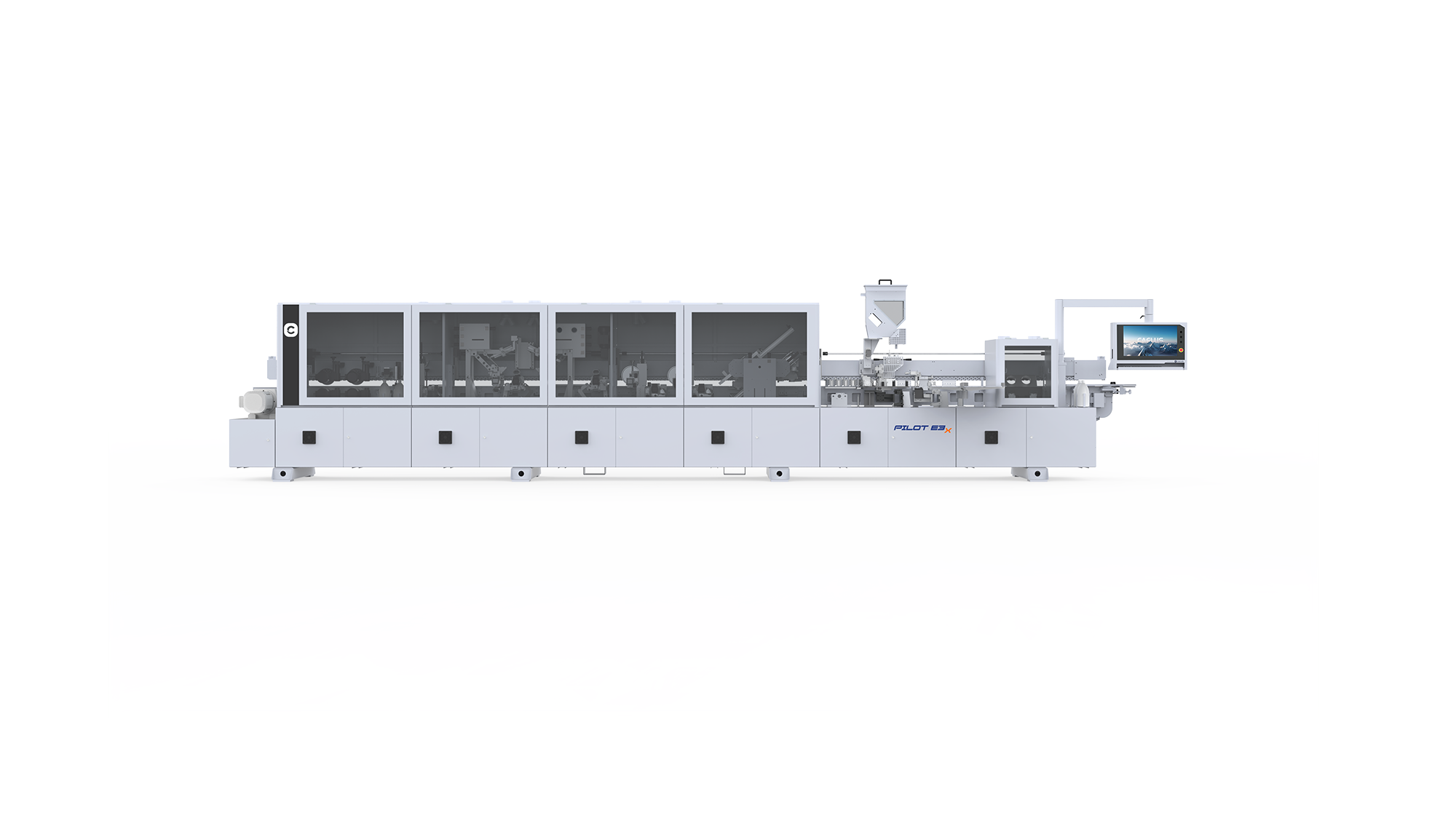
In contemporary panel furniture production, edge banding serves as a pivotal core process rather than mere surface finishing. It directly determines furniture visual appeal, moisture resistance, service lifespan and overall manufacturing efficiency.
For cabinet, wardrobe, office and customized furniture producers, consistent high-precision edge banding minimizes rework, elevates edge finishing quality and ensures steady production progress.
The automatic edge banding production line combines edge banding equipment with panel feeding, conveying, returning, intelligent parameter tuning and barcode-based production management systems. It integrates panel conveying, gluing, edge band feeding, trimming, scraping, polishing and waste recycling into a seamless continuous production process, eliminating the constraints of standalone single-machine operation.
What Is an Automatic Edge Banding Production Line?
It refers to an integrated intelligent manufacturing system that achieves full-process wood panel edge sealing, trimming, surface finishing and automatic material handling with minimal manual operation.
Built around professional edge banding machines, it supports matched feeding platforms, return conveyors, auto loading & unloading units, inline combined processing modules, barcode recognition and intelligent production scheduling systems. Unlike conventional single-function edge banders limited to independent edge processing, automatic edge banding lines optimize the entire edge-banding-centered production workflow.

Where Is an Automated Edge Banding Line Used?
Automatic edge banding lines are extensively adopted in panel furniture manufacturing, ideal for mass production and scenarios demanding stable uniform product quality.
Core Application Fields
- Kitchen cabinet fabrication
- Wardrobe and storage cabinet production
- Office furniture manufacturing
- Commercial furniture processing
- Custom panel furniture production
- Door panel & drawer face machining
- Large-scale panel furniture plants
- Flexible mixed-batch production lines
In such production scenarios, automated edge banding boosts decorative effects, safeguards board substrates, strengthens moisture-proof capability, prevents edge abrasion and damage, and greatly upgrades overall finished product aesthetics.
Where Is an Automatic Edge Banding Line Applied
Automatic edge banding lines are prevalently deployed in panel furniture manufacturing, perfectly suited for high-standard quality control and high-volume production demands.
Typical Application ScenariosKitchen cabinet fabrication, wardrobe production, office & commercial furniture making, customized panel furniture, door and drawer face machining, large-scale furniture factories, flexible mixed-order production lines.
Edge banding upgrades decorative effects, protects board cores, boosts moisture resistance, prevents edge wear and damage, and optimizes overall finished product outlook.
Core Components of Automatic Edge Banding Line
It consists of 12 key functional modules:
- Panel Feeding SystemStable panel delivery, available in manual and automatic types including lifting platforms and conveyors.
- Positioning & Conveying SystemSteady panel guiding via guide rails and pressing assemblies.
- Pre-milling UnitTrims rough board edges to ensure uniform gluing and firm edge band adhesion.
- Glue Application UnitSupports EVA, PUR, hot air and laser gluing. EVA fits regular furniture, while PUR serves high-humidity & moisture-proof usage.
- Edge Band Feeding SystemFeeds PVC, ABS and other edge bands, supporting automatic material switching for customized production.
- Press Roller AssemblyFirmly compresses edge bands with precise pressure to avoid loose bonding and glue overflow.
- End Cutting UnitNeatly cuts redundant edge bands, ensuring stable operation under high-speed production.
- Rough & Fine Trimming UnitsRemove surplus materials to form precise standard edge shapes.
- Corner Rounding UnitCreates smooth rounded edges for high-end furniture and visible panels.
- Scraping & Glue Removing UnitsEliminate machining traces and residual glue, essential for high-grade furniture production.
- Buffing & Polishing UnitPolishes edge surfaces for smooth finish and superior visual quality.
- Return Conveying & Handling SystemTransports processed panels to subsequent working stations, enabling seamless linkage with other production equipment.
CAELUS edge automation solutions dedicate to overall system integration to realize uninterrupted full-process edge banding production.
How an Automatic Edge Banding Line Works
Automatic edge banding lines complete full automatic edge sealing processes steadily, with all stations cooperating to ensure superior edge finishing quality.
- Feeding & PositioningPanels are fed and accurately positioned to avoid uneven processing, supporting stable high-speed production of various furniture boards.
- Edge Pre-millingRemove edge burrs to realize smooth surface and firm glue bonding.
- Precision GluingApply EVA/PUR glue scientifically. EVA for standard furniture, PUR for damp-proof furniture. Proper glue volume ensures strong adhesion without residue.
- Edge Band Feeding & PressingAuto feed edge bands and compress tightly to prevent loose bonding and glue overflow.
- End TrimmingTrim redundant edge bands neatly to avoid corner damage and manual rework.
- Rough & Fine TrimmingShape standard edge profiles to fit different types of thick edge bands.
- Corner RoundingMake smooth rounded edges for high-end furniture to enhance appearance and touch feeling.
- Edge ScrapingClear tool marks and residual glue for clean premium-grade edges.
- Edge BuffingPolish edges to brighten surface and upgrade overall product texture.
- Panel Transfer & SortingAuto deliver finished panels to next procedures, realizing intelligent linked production.
What Determines Edge Banding Quality
Premium edge banding equipment is necessary, yet final edge sealing quality relies on overall production conditions rather than machines alone.
- Panel Cutting PrecisionPoorly cut edges with chipping and size errors cannot be fully corrected by pre-milling. Stable pre-processing cutting lays a solid foundation for high-standard edge banding.
- Substrate Board TypeMDF, particle board, plywood, high-gloss panels and other materials differ greatly in heat resistance, pressure bearing and processing performance, requiring targeted processing parameters.
- Edge Band MaterialPVC, ABS, veneer, acrylic and solid wood edge bands have distinct processing demands. Their thickness, toughness and surface finish directly influence sealing effects.
- Glue Temperature & DosageConstant glue temperature ensures stable adhesion. Improper glue volume leads to obvious glue lines, glue overflow or edge band falling off.
- Dust Removal SystemProcessing dust ruins bonding effect and finished edge appearance. Efficient dust extraction is vital for steady high-quality edge sealing.
Types of Automatic Edge Banding Lines
Automatic edge banding lines are classified by layout and productivity to fit different production demands.
- Single-machine Edge Banding LineEntry-level mainstream type, equipped with one automatic edge bander plus simple feeding/returning structure. Suitable for medium and small factories pursuing cost-effective quality and efficiency.
- Edge Banding Line with Return ConveyorPopular for cabinet and wardrobe production. It sends panels back after single-side edge sealing, cutting manual handling and streamlining production flow.
- Double-machine Edge Banding LineDivides working procedures to lift overall output, effectively solve single-machine production bottlenecks for medium-volume production.
- Four-machine Edge Banding LineHigh-efficiency full automatic model for large-scale furniture manufacturers and smart production upgrading. It greatly cuts labor cost and maximizes production capacity.
- CAELUS provides professional double-machine and four-machine edge banding line solutions to meet diversified intelligent production needs.
How to Choose a Suitable Automatic Edge Banding Line
Choose edge banding lines according to actual production demands instead of superficial appearance.
- Confirm Production CapacityWork out daily output, working shifts, order types and material switching frequency.Mass stable production needs high speed & full automation; custom furniture requires flexible operation and fast parameter adjustment.
- Confirm Workpiece SpecificationsMatch panel size, thickness, edge band range and rounding standard. Focus on actual stable processing performance rather than nominal parameters.
- Select Proper Gluing SystemEVA for regular furniture, PUR for moisture-proof kitchen & bathroom cabinets, hot air/laser for high-end products. Multi-grade production needs multi-glue compatible equipment.
- Determine Reasonable Automation GradeSelect matched automation level based on current scale and future development, and arrange gradual equipment upgrading plans:
| Factory Stage | Recommended Configuration |
|---|---|
| Small workshop | Compact automatic edge bander |
| Growing cabinet factory | Edge bander with return conveyor |
| Medium furniture factory | High-speed edge bander with automatic adjustment |
| Large production plant | Two-machine or four-machine edge banding line |
| Smart factory | Edge banding line integrated with storage, cutting, and drilling systems |
5. Consider Operator Skill and Maintenance
A high-quality automated edge banding line should reduce operator difficulty, not increase it. Key factors to consider include:
- Clear control interface
- Automatic pressure beam positioning
- Servo adjustment
- Easy glue system maintenance
- Convenient tool replacement
- Reliable lubrication
- Accessible dust extraction points
- Practical training and after-sales support
Maintenance Tips for Automated Edge Banding Lines
Consistent high-precision edge banding performance depends on standardized daily maintenance. Without regular cleaning and upkeep of glue residue, dust buildup and worn parts, even premium edge banding machines will lose processing accuracy and stability.
Daily Maintenance
- Clean residual glue around the glue pot
- Check pressure rollers for wear and offset
- Clean conveyor chains and guide rails
- Inspect trimming and scraping units for normal operation
- Check buffing wheels for dirt and abrasion
- Verify stable working air pressure
- Ensure full-functioning dust extraction system
Weekly Maintenance
- Inspect cutting tools and replace worn components timely
- Check sharpness of scraper blades
- Clean sensors and limit switches
- Lubricate all required points sufficiently
- Check edge band feeding system for smooth running
- Adjust chain tension and ensure stable panel conveying
Monthly Maintenance
- Calibrate trimming and corner rounding accuracy
- Check spindles for abnormal wear
- Back up system and processing parameters
- Clean electrical cabinet to avoid dust accumulation
- Correct return conveyor alignment deviation
- Inspect glue system status and replace expired adhesive
Scientific, periodic maintenance minimizes equipment downtime, sustains consistent edge banding quality, and maintains long-term machine precision and service life.
Why Choose CAELUS Automated Edge Banding Solutions
CAELUS specializes in intelligent woodworking equipment for panel furniture manufacturing, offering edge banders, panel saws, storage systems, automation solutions and edge quality testing devices.
We deliver standalone edge banding machines and custom automated lines, fully adapted to cabinet, wardrobe, office and custom furniture production.
Flexible configurable functions include EVA, PUR and laser gluing, servo positioning, auto pressure beam, multi-slot feeding, high-speed trimming, corner rounding, scraping and buffing, supporting full automation integration.
We provide one-stop factory upgrading services, including process assessment, workshop layout optimization and full-process linkage of cutting, storage, edge banding, drilling and material handling.
Conclusion
Automated edge banding lines integrate feeding, alignment, pre-milling, gluing, pressing, trimming, finishing and returning into one stable production flow. CAELUS customized edge banding solutions help furniture manufacturers cut rework, stabilize edge quality, realize flexible production and improve overall factory efficiency.